
Short answer
To carry an overhanging load safely, strap it as close to the front of the rack as you can, choke the strap around both the load and a crossbar, take about 10% off the weight for every 10% of length past the rack, and keep solid sheets to about 800 to 900 mm of overhang. Check your state’s road rules for overhang limits and flags before you drive.
| Strap position | As close to the front of the rack as possible |
|---|---|
| Strap method | Choke around the load and a crossbar |
| Capacity | About 10% less for every 10% past the rack |
| Solid sheets | Keep overhang to about 800 to 900 mm |
| Road rules | Check your state’s overhang rules |
Sooner or later you’ll need to carry something longer than your rack, timber, extrusions, sheets. Overhanging is fine when it’s done right, but a long load catches wind and puts serious strain on the front of your rack. Get the strapping and the length wrong and you’ve got a problem at highway speed.
Here’s how to do it safely.
Strap Close to the Front
A long overhanging load generates a lot of lift. Wind comes up the windscreen and gets caught underneath the load, creating strong vertical up-force.
To counter it, strap as close to the front of the rack as you can. That’s where the lift is trying to pull the load up, so that’s where you want your anchor.
Choke the Load, and Involve the Crossbar
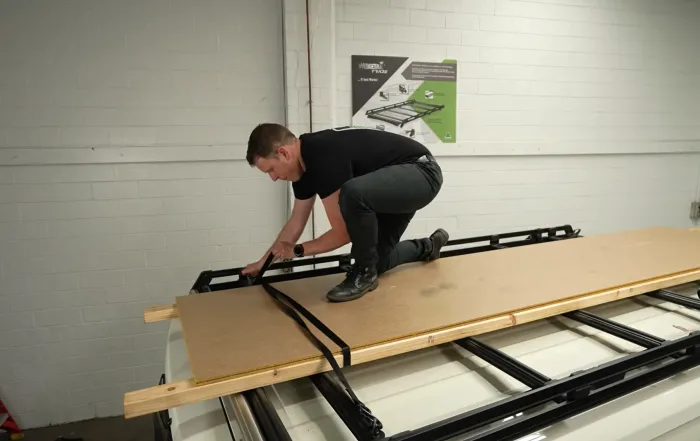
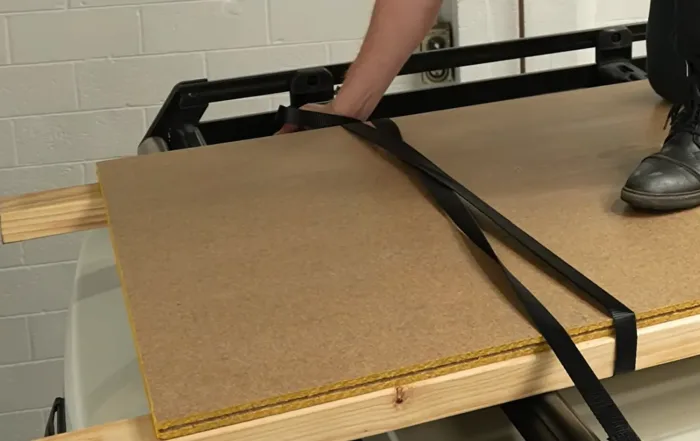
Don’t just strap over the top of the material. You want the strap wrapped around both the load and a crossbar:
- Choke the product with the strap
- Run under the crossbar, over the material, and back through
- The strap now loops around the material and the crossbar together
Tying it this way, through the crossbar rather than just over the load, makes the whole setup noticeably stronger and stops the load lifting away from the rack.
Leverage Is Your Worst Enemy
The real risk with overhanging isn’t just the weight, it’s the leverage. The further your load extends past the end of the rack, the more strain it puts on the front mount and feet. A modest weight on a long overhang can load those front feet far harder than the same weight sat squarely on the rack.
The 10% Rule
As a general guide: for every 10% you extend past the end of the rack, drop your carried weight (or rating) by 10%.
It’s a simple way to keep the load off the front mounts within safe limits.
Watch Out for Solid Sheets
Long timber is one thing. Solid sheets are another, they catch far more wind and put extreme pressure on the front feet at length.
Wedgetail racks are built strong enough to handle a lot of pressure, but as a rule of thumb, try not to overhang much beyond 800 to 900mm if you can avoid it. Keep it shorter where you can, strap it properly, and your rack, and your load, will thank you.
Load Smart, Travel Safe
Overhanging materials is completely doable with the right technique. Strap to the front, involve the crossbar, respect the leverage, and keep your overhang sensible. Do that and you’ll carry long loads confidently, without punishing your rack.
Questions and answers
Why strap at the front?
Wind comes up the windscreen and lifts the front of a long load; the front strap holds it down.
What is the 10% rule?
For every 10% the load extends past the rack, carry about 10% less weight.
How far can sheets overhang?
As a rule of thumb not much beyond 800 to 900 mm, and within your state’s road rules.
Which straps should I use?
Ratchet or tie down straps to the rack’s tie points; see tie-down points.
Related guides
SHARE THIS STORY
RECENT NEWS
How To: Load Long Materials on a Roof Rack
Short answerUse a platform with rollers and ratchet strap mounts and follow the overhang rules: for low profile loads such as posts and pipe, take about 10% off the carrying capacity for every 10% of [...]
Wedgetail at the National 4×4 Outdoors Show 2026
Australia's biggest 4x4 show is coming to Melbourne — and Wedgetail will be there. We're exhibiting at the National 4x4 Outdoors Show from 21–23 August 2026 at the Melbourne Showgrounds. Come and find us [...]
How To: Reduce Wind Humming Using the Strap Slap Method
Short answerMost roof rack whistle comes from open bar profiles and loose or flat straps; a leading edge wind deflector and the strap slap method fix most of it. Wedgetail includes a wind deflector on [...]